Anatomy of Fly Eyes
Compound Eye Structure
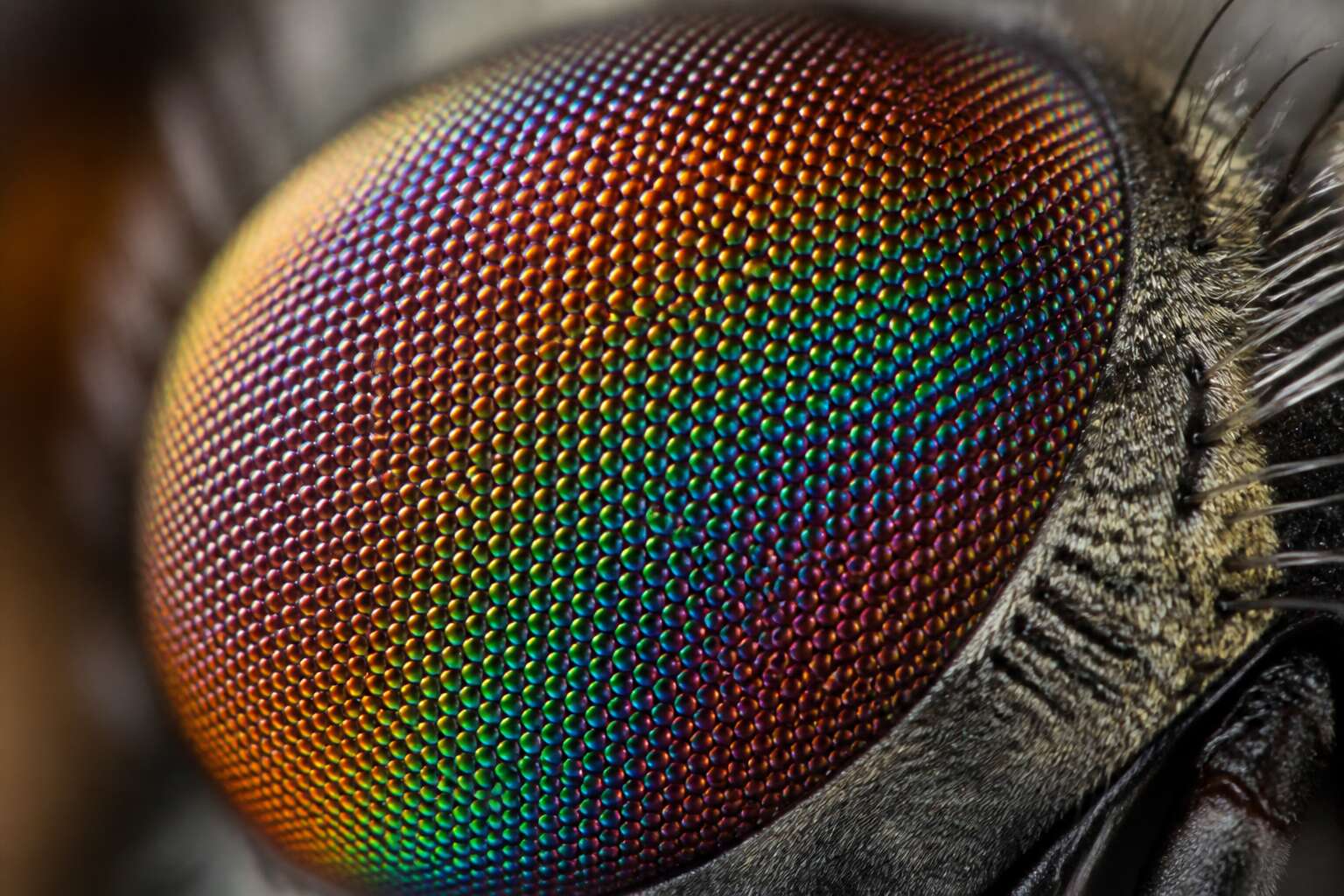
A single fly eye is a dense mosaic of thousands of individual light sensors, each functioning as its own tiny eye. This creates a world rendered in fragmented, low resolution detail, yet with extraordinary sensitivity to motion. The sheer complexity of the structure is staggering, and it is this very design that provides the insect with a nearly 360 degree field of view.
The fundamental units of this visual system are known as ommatidia. Each one contains its own lens and a cluster of photoreceptor cells, working in concert to capture a small slice of the visual field. The brain then stitches these separate signals together into a unified, albeit pixelated, image. For a human, the experience would be like looking through a massive kaleidoscope. To understand how this translates to survival, consider the visual capabilities this grants the insect:
– Motion detection is enhanced to an extreme degree.
– The field of vision is incredibly wide.
– Color perception is shifted towards the ultraviolet spectrum.
These adaptations rely on the precise arrangement of the lenses, which are typically arranged in a hexagonal pattern. Researchers study the geometric perfection of this array, known in scientific terms as a corneal lattice, to understand how the eye maintains its structural integrity. Beyond the main compound eyes, the anatomy is further complemented by simple eyes called ocelli. These smaller, more basic organs cannot form images, but they act as highly sensitive light meters. This dual system, combining high speed motion tracking with light intensity detection, means these creatures are exceptionally difficult to catch. Ultimately, the architecture of flies eyes is a masterclass in biological engineering, producing a visual experience that is completely alien to our own.
Ommatidia Explained
A single ommatidium contains eight photoreceptor cells, yet a fly eye can pack over four thousand of these units into a space smaller than a pinhead. When we study flies eyes at the microscopic level, each ommatidium functions as an independent optical channel.
The outermost element is a convex corneal lens, which directs light into a crystalline cone. Beneath the cone sit the eight photoreceptor cells. Each cell contributes a rhabdomere, a microvillar structure packed with light-sensitive pigment. The rhabdomeres collectively form a central light guide called the rhabdom.
Pigment cells wrap around the entire assembly, absorbing stray light that might otherwise bleed into neighboring ommatidia. This isolation is critical for preserving the direction of incoming light. The arrangement varies between species, but the core design remains consistent:
- Corneal lens
- Crystalline cone
- Photoreceptor cells with rhabdomeres
- Pigment cells
This layered precision is what gives flies eyes their remarkable efficiency.
The Role of Photoreceptor Cells
About 80% of a fly’s brain is dedicated to processing what its eyes capture, a fact that underscores the sheer importance of those tiny photoreceptor cells. While the structure of the ommatidia is fascinating, the real magic unfolds in the rhabdomeres, where light is converted into electrical impulses. These eight photoreceptor cells per unit are not interchangeable; they are specialized, each with a unique spectral sensitivity.
The rhabdomeres are essentially tightly packed photopigments that absorb different wavelengths of light in the flies eyes. This system allows the fly to perceive colour in a way that is more complex than our own trichromatic vision. They also excel at detecting the angle of polarised light. Because the microvilli within each rhabdomere are aligned, they act as a directional antenna for light waves. This skill guides the fly’s aerial navigation, which is particularly noticeable in the open landscapes of South Africa.
The role of photoreceptor cells extends beyond simple light detection. They are the first stage in a rapid visual processing chain. Here is what they calculate in microseconds:
– The contrast between adjacent ommatidia for edge detection.
– The velocity of an image moving across the eye for flight stabilisation.
– The spectral distribution of light to identify specific objects.
Without these cells, the fly would be flying blind, unable to react to a swatter or find a mate. They ensure that the mechanical structure of the cornea and cone is not just a passive lens, but an active component of a high-speed nervous system. The efficiency of this conversion is what gives flies eyes their legendary speed and accuracy.
Types of Eyes Found in Flies
Large Compound Eyes
Flies pack most of their vision into one dominant structure: large compound eyes. These organs take up the majority of the head, giving the fly a broad visual field. Flies eyes also differ between the sexes. Males often have holoptic eyes, where the two compounds meet along the top of the head. Females typically have dichoptic eyes, separated by a visible gap. This matters during mating, where males need faster visual tracking.
A few fly families show just how far large compound eyes can go:
- Horse flies have enormous compound eyes that excel in bright, sunny conditions.
- Robber flies use their large eyes to lock onto prey and intercept it mid-flight.
- Fruit flies depend on large eyes for quick course corrections when buzzing around.
These examples show how flies eyes vary, even when the basic type stays the same.
Simple Eyes (Ocelli)
Beyond the large compound eyes, a fly carries a hidden trio. Three ocelli sit on top of the head, each a simple lens backed by a few light sensitive cells. They do not build images. Instead, they track changes in brightness and sky polarization. This is enough for the fly to keep its horizon level during high speed turns.
The ocelli act quickly. A signal from these tiny organs reaches the flight muscles in milliseconds, far earlier than any response from the big eye arrays. For flies eyes, this split second advantage often means escaping a swatter instead of becoming a smear.
Sexual Dimorphism in Eye Structure
In many fly species, the eyes tell a story of gender before you ever inspect the body. Male flies often have holoptic eyes, where the compound surfaces meet along the top of the head, granting a single, unbroken visual field. Females typically show dichoptic eyes, with a distinct gap between them. This is not a minor detail; it changes how each sex perceives motion and locates mates.
Consider the stalk-eyed fly, a striking example of sexual dimorphism in eye structure. Males project their eyes on long stalks, while females keep them shorter. Among these flies, the span of the stalks advertises genetic quality.
– Male houseflies possess nearly 4,000 ommatidia per eye, while females have fewer.
– In drone honeybees, a related insect, the eyes are so large they cover most of the head.
Such variation in flies eyes shows how selective pressure shapes vision for very different lives.
Positioning and Field of View
Across the fly world, the placement of flies eyes on the head shapes how each insect reads the sky. Most species carry their compound eyes low and wide, wrapping the head in a curved arc. This arrangement grants a nearly 360 degree field of view, so the fly can track movement from almost any direction without shifting its body. Positioning is not uniform, however. Some species tilt their eyes forward for sharper depth perception, while others keep them set back to widen peripheral coverage. Eye placement also guides flight behaviour. A fly with front facing eyes judges distance differently when weaving through grass than one with lateral eyes.
Simple differences appear across families:
– High set eyes favour scanning above for predators.
– Wide, low eyes give balanced all around coverage.
– Forward leaning eyes improve binocular range for precise landings.
Each position trades one kind of awareness for another. Flies eyes are not a single design but a set of solutions shaped by habitat and survival demands.
How Flies Perceive the World
Visual Acuity and Resolution
A fly does not see fine detail. The world through flies eyes is a mosaic of thousands of tiny dots. Each dot comes from a single ommatidium, and the brain merges them into a rough grid. Visual acuity is poor, yet the system excels at detecting motion. A moving target triggers an instant response, while a stationary object fades from perception.
This trade-off defines survival. The temporal resolution of a fly is roughly five times greater than ours. We perceive a continuous blur; the fly perceives discrete frames. That speed gives it an edge we can hardly comprehend! In practice, a fly can process a swatter’s approach frame by frame. Clarity matters less than speed when you weigh a few milligrams.
Exceptional Motion Detection
A housefly can react to a moving threat in milliseconds, a speed that far exceeds our own reflexive response. Our eyes deliver a continuous feed. A fly’s eyes deliver rapid samples, each offering a distinct view of motion. This exceptional motion detection bundles several adaptations.
- Calculating the trajectory of a moving target in under 50 milliseconds.
- Distinguishing directional changes rapidly enough to land on a moving surface.
- Adjusting their flight path within a single wingbeat based on a moving object’s velocity.
The trade-off is a loss of fine detail. For flies eyes, motion is survival, and clarity is secondary. Speed wins, and humans are left swatting at nothing.
Color Vision and Spectral Sensitivity
Color is not a fixed reality; it is a product of the eyes that perceive it. For flies eyes, the visible spectrum shifts far beyond our own. Humans use three color receptors for red, green, and blue. Flies possess a different set, with sensitivity peaking in ultraviolet, blue, and green. This means a flower we see as purple may reveal a distinct UV pattern that guides a fly to nectar.
Their spectral sensitivity reaches into ultraviolet, a range invisible to us. This enables flies to detect polarized light from the sky, aiding navigation. The cost is a weak response to red; a red object likely appears as a dull grey.
- UV receptors peak near 350 nm
- Blue receptors peak near 460 nm
- Green receptors peak near 520 nm
This trichromatic system serves survival, not aesthetics. It is tuned to the wavelengths that matter for locating food and mates. When a fly lands on a flower, it perceives a world we cannot see.
Processing Speed vs. Human Vision
While your brain stitches together a seamless world from about 60 distinct images each second, a fly’s visual system operates on an entirely different clock. Flies eyes detect changes in light far more rapidly, with some species registering up to 250 flickers per second. This speed turns a slow waving hand into a sequence of frozen frames, which is why flies evade swats so effortlessly.
Time perception is relative. For a fly, a room light’s hum, which we smooth over, becomes a strobing pulse. Their neural pathways are wired for speed, sacrificing fine detail for split second reaction. This trade off means motion that appears smooth to us jumps like a slideshow to them.
In practice, this processing speed shapes every interaction. A fly sees the world in slow motion, giving it a decisive edge in escape and pursuit.
Unique Adaptations of Fly Eyes
Ultraviolet Vision Capabilities
Most people see a flower’s petals as purely decorative. Flies see a different reality. Their flies eyes are tuned to ultraviolet light, a spectrum hidden from our own vision. This capability stems from specialised photoreceptors that respond to wavelengths around 350 nanometres, which is why certain patterns on plants appear with high contrast to them.
These adaptations serve survival functions:
- Locating nectar guides that reflect UV
- Detecting predators against UV-absorbing foliage
- Distinguishing potential mates with species-specific UV signals
Through these lenses, a sunny Johannesburg garden reveals distinct visual cues. Flies eyes process this information rapidly, allowing split-second decisions that keep them ahead of threats. I find it remarkable how much detail exists beyond human perception, simply waiting for the right eyes to see it.
Sensitivity to Polarized Light
Light waves normally scatter in every direction. Polarized light arrives with a fixed orientation. Flies eyes measure this orientation with precision through microvilli arranged in parallel within each photoreceptor. The result is a set of perceptual abilities. The practical uses are concrete:
- Locating water surfaces through horizontal reflection patterns
- Navigating using the sky’s polarization pattern
- Discerning shiny surfaces that signal mates or food
Consider what this means. A fly crossing an open field perceives the sky’s electric field orientation. It knows direction without a single landmark. I find this humbling! Our eyes miss this information entirely. They read it constantly, making decisions that have defined their survival for hundreds of millions of years.
Flicker Fusion and Fast Reactions
A fluorescent tube hums at 50 to 60 cycles per second. To a human eye, that light looks constant. To flies eyes, it flickers visibly. This is the flicker fusion rate, the speed at which individual flashes merge into continuous light. Humans fuse at around 60 hertz. Many flies fuse at over 200 hertz. The world moves in slower motion for them!
That perception gap explains the swatter problem. A fly registers the approaching hand in distinct frames, while you see only a blur. Its escape reflexes fire in milliseconds. Leg muscles cock and release before the air pressure from the swing arrives. This temporal precision is a survival requirement. Flies eyes trade sharpness for speed, and the trade has kept them ahead of every swatter in history.
Night Vision in Nocturnal Flies
Nocturnal flies face a different challenge. Their world dims to near darkness, yet they still navigate and mate. Many species solve this with superposition eyes, where multiple ommatidia gather light from the same angle. This design amplifies every photon, but it sacrifices sharpness. The trade is necessary.
I have watched these flies at dusk, how they dodge between shadows. Their flies eyes collect light through larger lenses and neural pooling. Stacking signals from adjacent receptors boosts sensitivity. The results are impressive! They can detect movement at light levels a human would find impossible.
Here is a list of adaptations seen in nocturnal species:
- Larger lenses to catch more light
- Wider rhabdoms for greater photon absorption
- Slower photoreceptor responses to improve signal strength
This combination allows them to operate where diurnal flies cannot. Night vision in flies eyes is an extreme example of evolutionary fine tuning.
Comparing Fly Eyes with Human Eyes
Differences in Eye Design
A human eye captures a single, seamless image. A fly’s eye assembles a world from thousands of tiny visual fragments. That fundamental difference in eye design drives everything else.
The human eye uses one flexible lens and a curved retina to project a focused picture. The flies eyes, however, have no single lens. Each ommatidium gathers light from one narrow angle, and the fly’s brain stitches these thousands of samples into a combined view. This architecture offers an expansive field of vision, but it does not produce the same detail. Human eyes deliver a continuous, high resolution scene. These eyes deliver a fragmented, motion sensitive picture. The design of each eye reflects the survival demands of its owner.
Field of View and Blind Spots
Stand still and stare ahead. Your peripheral vision stretches roughly 180 degrees, yet a gap exists where the optic nerve exits the retina. That gap is a true blind spot, a silent absence your brain fills with guesswork. Flies eyes operate differently.
A fly’s compound eyes wrap around the head, granting nearly 360 degrees of coverage. The only real blind spot sits directly behind. This difference shapes perception itself.
- Humans sacrifice breadth for depth and detail.
- Flies sacrifice resolution for survival, detecting threats from almost any direction.
We see what we look at. Flies eyes see what approaches. That trade-off is a compromise each species accepted for its own survival.
What Flies See vs. What Humans See
A fly does not see the world as a blurry copy of your own. It sees a different rendering entirely.
Humans rely on foveal focus, a sharp central point that lets us study details. We move our eyes in quick jumps called saccades, stitching together a vivid mental picture. Flies eyes have no such luxury. They cannot focus on a single object. Instead, they perceive a continuous, wide-angle flow where motion dominates and stillness fades into the background.
Consider the priorities of each visual system:
– A human reads expressions, identifies objects, and recalls faces.
– A fly detects movement, judges distance, and reacts in milliseconds.
Neither system is superior. We process meaning. Flies eyes process change. Each species interprets the same world through senses built for entirely different goals.
Evolutionary Advantages of Compound Eyes
An entomologist once remarked that a fly’s eye is built for motion, not for meaning. That observation captures the evolutionary divide between flies eyes and human eyes. A human eye is a precision instrument for reading faces and interpreting social cues. A compound eye is a detection apparatus for survival. The evolutionary advantage of flies eyes lies in their ability to process change without delay. The compound design distributes thousands of ommatidia across a curved surface, granting flies a near-panoramic awareness. Human vision depends on foveal focus and rapid saccades. Fly vision depends on continuous, wide-angle processing.
The trade-offs are instructive:
– Human eyes resolve fine detail and depth.
– Flies eyes detect movement from nearly every direction.
– Human eyes function well in dim light through larger pupils.
– Compound eyes register changes at speeds humans cannot perceive.
Each system evolved to meet a different social obligation. One reads a crowd. The other reads the air.



0 Comments