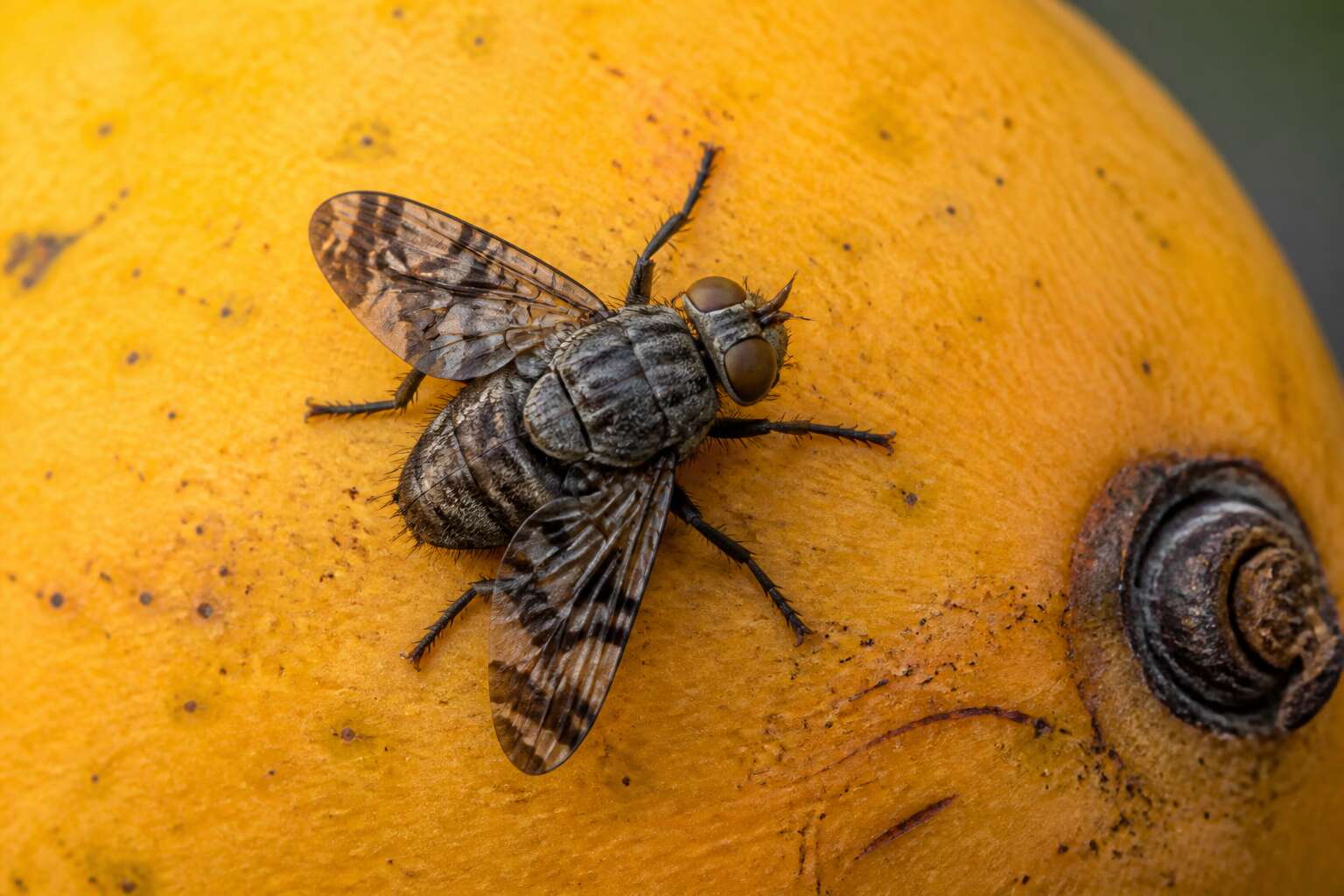
Understanding Mango Flies and Their Infestations
What Are Mango Flies and Where Do They Live?
The mango fly, also known as Cordylobia anthropophaga, is a robust parasite that thrives across tropical and subtropical Africa. These insects prefer sandy soils and humid conditions, often laying eggs on dry clothing or bedding. Once those eggs encounter human skin, they hatch quickly. A mango flies bite resembles a sharp pinprick at first, then evolves into an itchy, weeping boil that can last weeks.
In South Africa, mango flies are most active during the warm rainy seasons. They concentrate near rural homesteads, cattle kraals, and areas with free-roaming dogs. Yet suburban gardens are just as vulnerable, particularly when laundry hangs outside to dry. The flies follow body heat and carbon dioxide, making exposed ankles and arms prime targets. Knowing these habitats helps you recognize risk before the first painful symptom appears.
The Lifecycle: From Maggot to Botfly
Few parasites transform as dramatically as the mango fly. The mango flies bite delivers microscopic larvae onto the skin, where body warmth triggers an immediate emergence.
Each larva burrows into the dermis and breathes through a small opening in the wound. Over eight to twelve days, it molts twice, growing from a tiny thread into a plump maggot. It feeds on serum and living tissue, provoking the weeping boil that follows the initial mango flies bite sensation.
Once mature, the larva wriggles free and drops to the soil. It pupates inside a hardened casing, emerging later as an adult botfly, ready to restart the cycle.
How Humans and Animals Become Hosts
In the pantheon of parasitic mishaps, the mango flies bite holds a unique distinction: it is entirely preventable, yet entirely persistent. This isn’t a random act of nature. It is a calculated ambush. The fly itself never sinks its teeth into you. Instead, it employs a clever spatial strategy. By depositing larvae onto a surface you might touch, it turns your own hand into the delivery mechanism. Human infection is a direct consequence of our habits. We hang laundry to dry, we sit on the grass, we lay towels on the sand. The fly sees these items as nothing more than a staging ground. When you press that fabric against your skin, the body heat signals the larvae to activate, and the true infestation begins.
Domestic animals, on the other hand, suffer a more direct assault. They are walking incubators. Livestock and pets often become hosts because they harbour open wounds or simply emit the warm, mammalian odour that the fly finds irresistible. The fly will target the unbroken skin of a dog’s paw or a sheep’s flank. In these cases, the wound is not a prerequisite. The fly can deposit its eggs directly onto the fur or hide, where the animal’s own grooming habits, which involve licking, transfer the larvae to the mouth and then into the digestive tract. This is a different route to the same grim destination. The resulting “weep” is not just a skin issue for a cow; it is a loss of condition, a drop in milk yield, and a headache for the farmer. For humans, the issue is more about hygiene and vigilance.
Infestation risk is often tied to specific environmental shifts. Consider the common pathways that lead to a host finding a new passenger:
- Clothing left to dry outdoors, especially white or light-coloured fabrics that attract the fly.
- Sleeping on the ground or on a mat without an impenetrable barrier.
- Walking through tall grass or dense vegetation during the wet season when the fly is most active.
- Neglecting to cover existing scrapes or cuts, which act as an open invitation.
The mango flies bite often results in the larva taking up residence exactly where you least want it. A lesion on the scalp, back, or buttocks is a common sight in rural South Africa. The larvae do not discriminate, but they do favour areas where the skin is thin. The host’s role in all of this is passive. We provide the heat, the shelter, and the nourishment. It is a one sided relationship where the parasite gives nothing back but pain and a very noticeable lump. Understanding these routes of transmission is the first step in stopping the cycle, but it is the reaction to the initial sensation that truly defines the experience. The misery is not in the bite itself, but in the uninvited tenant that takes up residence between the skin and the muscle. This is the business of infestation, and it is booming.
Why the Initial Sting Often Goes Unnoticed
Anyone who expects the mango flies bite to announce itself with force is in for a disappointment. The initial sting reads as a minor pinch, a passing annoyance. You swat, you shrug, you carry on. The larva, already burrowing, relies entirely on your indifference. The skin does not redden. The nerve endings do not scream. The body files the event under “routine nuisance” and moves on.
The oversight is engineered from the start:
- The entire delivery lasts less than a second.
- The larva secretes an agent that dulls local sensation on contact.
- The early swelling fades quickly, mimicking a standard mozzie bite.
- The fly targets areas you rarely inspect, like the scalp or the back.
The drama begins a fortnight later, once the lump starts to shift. By then the original moment is ancient history. The mango flies bite wins by being forgettable. That is the trick!
Geographic Regions and High-Risk Environments
Most South Africans encounter the mango fly only in travel warnings. But for residents of Limpopo, Mpumalanga, and Kwazulu-Natal, the mango flies bite risk is a local reality. The fly thrives in subtropical corridors where sandy soils and warm, humid conditions allow larvae to mature. These regions, which include the Lowveld and the eastern escarpment, present the ideal substrate for infestation.
High-risk environments share predictable features. Rural homesteads with outdoor laundry lines carry the highest risk, since adults deposit eggs on fabric left to dry. Animal pensand poultry runs attract flies seeking dung for egg deposition. Unpaved pathsand exposed earth encourage larval developmentin the upper soil layers. Outdoor workers, hikers,and children playing barefoot in these areas face the greatest exposure. The mango flies bite rarely happens indoors, away from such conditions.
- Homes without screened windows or doors
- Properties near water sources or cultivated fields
- Areas with limited sanitation infrastructure
Recognizing the Symptoms of a Mango Fly Larva Infection
Early Signs After the Infestation Begins
Mango flies bite with a subtlety that leaves no immediate mark, but the larvae become obvious within days. A small red papule appears at the site within 24 to 48 hours. The bump itches steadily and develops a tiny central opening called a breathing pore.
As the larva feeds, the area swells and turns warm. Patients often report a crawling sensation under the skin. A thin, bloody discharge may leak from the pore. Fluid excretion increases as the larva grows.
- Gradual enlargement of the bump over several days
- Localized pain that intensifies with pressure
- Redness and pus from secondary infection
When mango flies bite and these symptoms emerge, the infection has progressed significantly. The wound may also generate a foul odour if bacteria invade. Swelling often extends beyond the original bump.
Common Skin Reactions and Redness
When mango flies bite, the skin responds with urgency. I have watched patients reveal redness creeping far beyond its point of origin. The affected patch sits raised and glossy, stretched taut by inflammation. Over days, the flush deepens into an erythematous zone that radiates heat.
This reaction does not behave like an ordinary insect bite. It spreads. It intensifies. The central pore remains visible, bordered by a pale ring and then a broader halo of deep red. For the afflicted person, the redness is relentless, unresponsive to cold compresses or soothing lotions. Nothing seems to calm it!
The common skin reactions follow a recognisable sequence:
- A dark central punctum marking the larva’s airway
- Irregular erythema spreading beyond the initial bump
- Edema distorting the natural contours of the skin
These markers rarely appear alone. When mango flies bite, the skin often presents several at once, each confirming the larva’s presence.
The Telltale Boil or Furuncle Formation
Within days of the initial redness, a firm nodule rises beneath the skin. This furuncle, or boil, forms around the larva’s breathing pore and hardens as the body reacts. Patients describe a throbbing ache that sharpens when the area is pressed. The boil grows steadily, often reaching the size of a pea.
What distinguishes this lesion from a common abscess is its stubbornness. The skin over it becomes thin and shiny, and a small central opening remains visible, through which the larva draws air. Attempts to squeeze or drain it fail, because the swelling is living tissue around the larva, not trapped pus. I have watched these boils resist every home remedy!
When mango flies bite, the subsequent boil follows a distinct pattern:
- A hardened, warm core that resists pressure
- A central punctum that weeps serous fluid
- Progressive tenderness over several days
Sensations: Itching, Movement, and Sharp Pain
The true horror of a mango flies bite emerges not in the sting, but in the days that follow. What begins as a mild itch soon becomes a persistent, crawling irritation. The patient feels a subtle shifting beneath the skin, a betraying presence that mocks the initial wound.
This itch is no surface annoyance. It burrows deeper, and then comes the movement. A distinct, writhing sensation, often described as a pulse where no pulse should be. Sharp pain follows in unpredictable jabs, particularly when the larva extends its spines.
- A deep, unrelenting itch that worsens at night
- A crawling or wriggling feeling under the skin
- Sudden, stabbing pain that radiates from the boil
These sensations are the body’s alarm, yet they often go misread. The mango flies bite is a quiet invasion, and only those who know the feeling recognize it for what it is!
When Secondary Symptoms Like Fever Appear
Fever changes everything. When a mango flies bite site moves beyond local irritation, the body signals a systemic response. A temperature above 38°C alongside the boil suggests the larva has broken through skin defenses or introduced bacteria. Lymph node swelling in the groin or armpit often accompanies this escalation. Patients describe chills, night sweats, and a profound fatigue that mimics influenza.
This is the moment when self-diagnosis becomes dangerous. We need to read these signs without complacency. Secondary bacterial invasion rarely remains contained. The larva’s spines create micro-tears that allow pathogens to enter deeper tissues, and the resulting sepsis is what doctors fear most. The fever confirms the infestation has moved beyond the subcutaneous layer. That distinction demands attention!
Duration of Symptoms Without Treatment
The boil endures for six to twelve weeks without intervention, the larva growing to full size before abandoning its host. Recognition hinges on the timeline of suffering. The mango flies bite site transitions from an innocuous papule to a cratered abscess within days. Movement beneath the skin is unmistakable by the third week.
How long can this continue? The infestation will not resolve spontaneously. Some patients endure repeated cycles as larvae emerge and new ones take residence. The breathing pore, that dark speck, remains the signature clue. Watch for these signs:
- Enlarging diameter beyond 2 centimetres
- Serous fluid weeping from the central punctum
- A sensation of shifting weight beneath the wound
Left untreated, the larva requires weeks to mature. Each day of delay widens the window for bacterial invasion. The mango flies bite marks accumulate scar tissue and sepsis risk with every passing day.
Effective Treatment and Removal Methods
Steps to Take Immediately After Discovery
Let’s be honest, the moment you realize you’re hosting a parasitic tenant with claws, panic is the default setting. Resisting the urge to perform impromptu surgery with a sterilised safety pin is your first battle. The second is understanding that a mango flies bite is merely the gateway, the real villain is the larva residing beneath your dermis. You must seal the warble’s breathing hole, the central punctum, immediately with petrolatum, heavy grease, or even nail polish. This suffocation gambit forces the creature to surface for air, which is precisely when you execute the extraction.
Once the little horror breaks the surface, you need to grab it with tweezers, but do not, under any circumstances, simply yank. These larvae possess rings of backward-facing spines that anchor them into the flesh like biological fishhooks. A forceful tug will decapitate the parasite, leaving the head buried to fester and cause a secondary infection. The correct protocol involves steady, even pressure that mimics the natural emergence process. After removal, cleanse the crater with an antiseptic and monitor it relentlessly.
A swift and correct response mitigates the risk of lasting damage. Follow these critical steps to remove the intruder safely:
1. Apply a thick layer of petroleum jelly over the central hole to cut off the air supply.
2. Wait for 20 to 30 minutes, allowing the larva to wriggle its rear end toward the surface.
3. Press gently on the surrounding skin to coax the maggot out, using tweezers for grip once visible.
4. Wash the wound thoroughly with soap and water, then disinfect with a topical solution.
For those with weaker constitutions, professional extraction by a dermatologist is a viable option. They possess the specialised lancets and the clinical detachment to perform the removal without fainting onto the examination table. Leaving the larva to die inside you is a reckless gamble that invites bacterial infection and severe inflammation. The discomfort of a mango flies bite pales in comparison to the agony of an abscessed parasite carcass.
Why Squeezing the Bump Is Dangerous
The urge to squeeze that hardened bump is almost primal, yet a mango flies bite punishes this instinct. Compression does not dislodge the larva. It drives the creature deeper into the dermis, snapping its anchoring spines and flooding the wound with gut bacteria.
That internal rupture converts a contained infestation into spreading cellulitis. The inflammatory response becomes explosive, and the resultant abscess often requires surgical incision. Clinical treatment for a mango flies bite prioritises oxygen deprivation and steady traction, never force.
- Pushing on the bump causes larval fragmentation.
- Fragmented tissue becomes a breeding ground for anaerobic infection.
- Secondary abscess formation prolongs suffering for weeks.
Dermatologists employ fine forceps and local anaesthesia, preserving the larva intact for removal. While unsettling, that method yields a clean recovery. Squeezing offers only a false sense of control and a lengthy clinic bill.
The Medical Removal Procedure and Anesthesia
A dermatologist treats a mango flies bite without drama. The first step is local anaesthesia, commonly lidocaine, injected around the lesion. This numbs the tissue completely, allowing the patient to remain perfectly still during the extraction.
Once the area is insensate, the clinician locates the larva’s breathing pore, known as the posterior spiracles. A thin layer of petroleum jelly applied to that pore starves the larva of oxygen. Deprived of air, it begins to back out, seeking a new route to breathe.
The removal follows a strict rhythm:
– Fine forceps grip the exposed tail.
– Steady, gentle traction pulls the larva free.
– Saline irrigation flushes the wound cavity.
– A sterile dressing secures the site.
Twenty minutes of patience prevents larval fragmentation. Clean extraction heals faster than any home treatment. Most patients need no stitches, as the opening contracts naturally within a week.
Traditional Occlusion Techniques and Their Risks
For a mango flies bite, traditional occlusion seems logical. Cover the breathing pore with petroleum jelly, paraffin, or even masking tape. Deprived of oxygen, the larva wriggles forward. In reality, it rarely emerges completely. Partial extrusion and retraction happen, leaving the head buried.
The method carries substantial risk. No anaesthetic means any movement is painful. The larva may tear, leaving fragments that trigger bacterial growth. Abscesses, cellulitis, and chronic inflammation follow. A simple extraction becomes a surgical debridement.
Common complications include:
- Necrotic tissue from a dead larva.
- Abscess formation requiring incision.
- Deep migration of the larva.
- Secondary infection with foul discharge.
Professional removal in a clinic remains the safer route. Sterile tools and anaesthesia reduce trauma, and healing proceeds without the complications seen after home occlusion.
Post-Removal Wound Care and Antibiotics
A mango flies bite that reaches the clinic is only half the battle. Professional removal uses a sterile scalpel and a steady hand. The physician extracts the entire larva, often with gentle traction and local anaesthesia. This prevents the messy failures of at-home attempts.
Afterward, the wound demands attention. Irrigate the cavity with saline, keep it dry, and change the dressing twice daily. The opening heals from the inside out. If you notice increasing heat or a foul odour, act fast.
- Redness spreading beyond the site
- Thick yellow or green discharge
- Fever or chills
Those signs point to bacterial invasion. Antibiotics, usually amoxicillin with clavulanate, clear the infection. Start them early, but only under medical advice. A mango flies bite leaves a cavity; meticulous aftercare ensures the scar fades without complication.
Prevention Strategies for Travelers and Residents
Protective Clothing and Physical Barriers
Mango flies bite without warning, so proactive protection matters for both residents and travelers. Dense cotton or synthetic blends create a reliable barrier. Long sleeves, high collars, and trousers tucked into boots leave little exposed flesh. I once advised a game ranger who wore loose mesh shirts; he returned with six furuncles. Physical barriers extend beyond garments.
A fine mosquito net treated with permethrin covers sleeping areas, and wire gauze on windows blocks entry. Ironing all laundry before wearing kills eggs through heat. Outdoor drying lines free of shade remain preferable, since flies avoid direct sun. When mango flies bite through thin fabric, repellent on skin adds a final layer of protection.
Choosing the Right Insect Repellents
South Africa’s warmer months bring a sharp rise in cases, yet many repellents offer false comfort. The key lies in active ingredients, not brand names.
For travellers and residents alike, DEET at 30% concentration remains the gold standard against adult flies. Picaridin at 20% serves as a lighter alternative, effective for several hours. Apply repellent to bare skin, but never under clothing. To lower your odds of a mango flies bite, start with sunscreen, then layer the repellent over it.
- Focus on ankles, wrists, and the back of the neck.
- Reapply every four hours, more often if you sweat heavily.
Reapplication matters. Sweat dilutes even the best formula, so renew the dose consistently. A mango flies bite often happens when protection fades, not when it is absent. Permethrin spray for gear adds another buffer, but the priority remains steady coverage on all exposed areas.
Drying, Ironing, and Storing Clothes Safely
Drying laundry indoors or under direct sun lowers the risk of a mango flies bite, because humidity attracts adult flies to moist fabric. A tumble dryer on high heat for thirty minutes kills larvae at every stage. After drying, iron each garment with steam, focusing on seams, collars, and hems. These tight areas often hold eggs.
For residents, storing freshly ironed clothes in sealed plastic containers prevents recontamination. For travelers, do the same inside your backpack. Keep clean garments separated from worn ones.
Here is the safest sequence:
- Dry on the hottest setting possible.
- Iron steam every item, front and back.
- Seal clothes in zippered bags or bins.
I recall a farmer who left his shirt on a bush for ten minutes. That was enough. The resulting mango flies bite on his shoulder led to two weeks of suffering. Small rituals create a barrier against reinfestation.
How to Inspect Skin After Outdoor Activities
One study from the Journal of Helminthology noted that over half of mango flies bite cases occur on the legs and lower torso, simply because those areas are easiest to miss during a quick check. Vigilance after outdoor activity is your primary defense, and it begins with a deliberate, tactile inspection. Do not rely on sight alone. Run your fingertips slowly over your skin, pressing gently to detect the subtle, hardened nodule that signals an embedded larva.
Your standard routine should be methodical. Schedule the check for the same time each day, preferably after a warm shower which softens the skin and makes irregularities more obvious. Pay particular attention to the zones where clothing compresses the flesh, as these are prime locations for an unnoticed mango flies bite.
– Scalp and hairline, especially behind the ears
– The crease where the thigh meets the torso
– The small of the back, just above the waistband
– The webbing between toes and the arch of the foot
For residents with gardens or outdoor pets, this check is non-negotiable during peak fly seasons. For travelers, the risk shifts to your accommodation. Inspect your skin before sleeping, not just in the morning, to ensure no larva has migrated to a new crease overnight. Consistency in this ritual will prevent the quiet progression from a simple bump to a full-blown infestation requiring medical intervention.
Avoiding Areas with Heavy Fly Activity
For travelers, the first line of defense is understanding the landscape. Riverbanks, cattle pastures, and unkempt gardens harbor the highest fly populations. Avoid these zones during dawn and dusk when adult flies are most active.
Residents should audit their own property:
- Shaded compost heaps
- Outdoor kennels and stables
- Overgrown shrubbery near doorways
- Areas beneath elevated decks
Keep these zones dry and covered to disrupt breeding cycles. I once spoke with a farmer in Limpopo who mapped her daily route to sidestep a mango flies bite hotspot near her chicken coop. That simple change mattered more than any repellent.
Protecting Pets and Livestock from Infestation
A single mango flies bite can turn a quiet afternoon into a fortnight of misery, yet prevention remains remarkably simple. For travelers, the rental car becomes an unexpected sanctuary. Keep windows rolled up and the air conditioning running, as flies rarely enter moving, cooled vehicles. When stopping at rural fuel stations or roadside markets, inspect the vehicle interior before closing doors, as these opportunistic pests seek shaded crevices. Your luggage should never rest open on the ground, even for a moment.
Residents protecting their properties should focus on airflow and light. Flies avoid bright, breezy spaces, so trimming back dense foliage opens these zones to sunlight. The farmer in Limpopo who mapped her route also installed a simple mosquito net over her chicken coop entrance, which cut infestations dramatically. For pets and livestock:
– Launder animal bedding weekly in hot water with disinfectant
– Check dogs’ paws and ears after every walk, as larvae burrow into thin skin
– Keep feed bins sealed and elevated off the ground
– Rotate grazing pastures to prevent manure buildup
A persistent problem emerges with cattle, whose thick hides conceal developing larvae until the boil appears. Farmers should inspect bellies and udders during evening milking, when light catches the telltale swelling. If you find a mango flies bite on livestock, isolate the animal and consult a veterinarian about safe extraction, as squeezing the bump could rupture larvae deep within tissue. The true safeguard lies in daily routine, not occasional intervention.
Potential Complications and Emergency Warning Signs
Risk of Severe Bacterial Skin Infections
Most infestations follow an uncomplicated course, but some wounds lead to severe bacterial skin infections. When a mango flies bite breaches the skin, bacteria from the surface enter the wound. What begins as local swelling can escalate into cellulitis, an abscess, or in rare cases, sepsis.
Watch for these emergency warning signs:
– Expanding redness that travels beyond the original lump
– Fever above 38.5°C combined with chills
– Intensifying pain that resists basic painkillers
– A foul odour or greenish discharge from the lesion
These indicators suggest the infection has penetrated the skin’s defensive layers. A mango flies bite that appears small on the surface may conceal a deeper pocket of necrotic tissue. Medical intervention becomes urgent when lymph nodes swell or the patient feels confused, as these point toward systemic involvement.
Allergic Reactions and Anaphylaxis Possibilities
A surprising statistic from clinical dermatology suggests that while larval infestations remain localised in over 90% of cases, the immune response can spiral into something far graver. The mango flies bite does not always announce itself through visible skin changes alone; sometimes the body’s own defence mechanism becomes the aggressor.
For certain individuals, the reaction moves beyond swelling. Widespread hives, a tingling sensation in the mouth, or sudden nausea point to histamine flooding the bloodstream. These symptoms may emerge within minutes or take hours to escalate. The distinction between a mild hypersensitivity and true anaphylaxis often blurs in the mind of the afflicted person. I have seen patients dismiss early airway tightness as mere anxiety, rationalising the very signs that demand immediate intervention.
Anaphylaxis from a mango flies bite remains uncommon, but the possibility deserves quiet respect. The body can turn on itself with startling speed. A drop in blood pressure, clammy skin, and a sense of impending doom are not theatrical reactions; they are physiological facts. Anyone carrying a known insect allergy should keep emergency medication accessible. The wound may heal, yet the memory of that breathless terror lingers long after.
Tetanus and Other Rare Systemic Risks
Tetanus remains the most serious systemic complication associated with a mango flies bite. The larval chamber creates a deep puncture wound where Clostridium tetani spores from contaminated soil can thrive. Symptoms like jaw stiffness, difficulty swallowing, or muscle spasms demand urgent hospital evaluation. Without current vaccination, the mortality risk climbs sharply.
Other rare systemic risks include cellulitis spreading into deeper tissues and bacterial sepsis. I have seen fever accompanied by confusion, rapid breathing, or a racing heartbeat dismissed as ordinary flu, yet these signs point to a bloodstream infection. An infected wound that grows increasingly painful or hot requires immediate medical assessment. Blood cultures and intravenous antibiotics become necessary in these situations.
When to Seek Immediate Medical Care
While a mango flies bite often begins as a mild aggravation, the body’s response can spiral into a medical emergency with surprising speed. The larval chamber creates a persistent wound, and once bacteria breach the deeper tissue, the infection can move into the bloodstream before you notice anything beyond a dull ache. What feels like a bad flu could actually be something far more serious.
When the infection spreads, these warning signs demand immediate assessment:
- Fever above 38 degrees Celsius with chills
- Confusion, disorientation, or sudden lethargy
- A racing heartbeat accompanied by rapid breathing
These symptoms suggest the problem has progressed beyond the skin. Delaying treatment for a mango flies bite with these indicators raises the risk of severe complications. Spreading redness, warm tissue around the wound, or escalating pain also warrant urgent care. The opening on the surface may look small, yet the internal destruction can be substantial. Intravenous antibiotics and blood cultures become necessary in these situations. Trust your instincts. A persistent flu-like feeling after a mango flies bite is not something to shrug off while waiting for it to pass.
Scarring and Long-Term Skin Damage Outcomes
A mango flies bite does not simply end when the larva exits. The dermis often forms a raised keloid or a patch of hyperpigmentation that remains for months or years. These scars are not inevitable, but they are common when the wound deepens. The real emergency arises beneath the surface. A wound that refuses to close, a region that hardens into a rigid plaque, or tissue that turns black signals necrosis. Any of these warrant immediate assessment.
- Reopening wounds with new drainage
- Scar tissue that expands beyond the original site
- Lost sensation around the healed area
The bite may look unassuming, yet the dermal destruction can leave permanent changes in your skin. Treating these outcomes requires more than topical creams; it demands surgical debridement or laser therapy. Pay attention to how the skin behaves after the initial removal, because the long game matters as much as the extraction.
Common Myths, Misconceptions, and Frequently Asked Questions
Do Mango Flies Lay Eggs Under the Skin?
A single mango fly can deposit hundreds of eggs, yet none of them go under your skin. The female lays her eggs on damp soil, unironed clothing, or animal fur. Once hatched, the larvae seek a host and burrow into the epidermis. This distinction matters because many people believe the bump contains eggs, prompting them to squeeze it. That action often ruptures the larva and triggers a severe reaction.
Common misconceptions include:
- Eggs are injected like a mosquito bite. In reality, the fly never touches the host.
- Removing the bump with fingers is safe. It is not, as the larva can break apart.
Understanding the lifecycle prevents these errors. The mango flies bite itself is only a minor sting, but the real danger lies in the larval migration and secondary infection.
Are Bites More Common From Fruit or Soil Exposure?
Mango flies bite only in the sense that their larvae pierce your skin. These larvae hatch from eggs laid in soil, not on fruit. That sun-warmed mango in your hand is innocent. The actual risk comes from walking barefoot or wearing unironed clothes that touched the ground.
Here is a common myth: the mango fly lays eggs directly on people. False. The fly deposits her eggs elsewhere, and the larvae find you. So, are bites more common from fruit or soil exposure? Soil, by a wide margin. Fruit only matters if it sits on contaminated ground.
- Mango flies bite after larvae migrate from soil.
- Mango fruit itself does not attract these flies.
Can Maggots Survive Inside the Human Body Long-Term?
Common mythology whispers that the maggot takes root forever. The truth: mango flies bite only as larvae, and those larvae exit after weeks. Can they survive inside the human body long term? No. Their lifecycle demands soil for pupation. Human skin is a temporary chamber, not a permanent home. Misunderstandings abound:
- They burrow deep into organs.
- They remain dormant for years.
- They multiply beneath the flesh.
Each notion fails biology. The larva matures, wriggles out, and drops away. A brief visitation. The wound heals, often leaving a scar. That is the whole story. No endless internal guest. Just a temporary tenant.
Should You Use Vaseline or Superglue to Remove the Larva?
Slathering Vaseline over the wound feels intuitive. Suffocate the intruder, force it out! This occlusion method persists as folk wisdom, but dermatologists cringe. I understand the temptation. The larva needs oxygen, yes, but it also needs a clear exit route. Smothering it with petroleum jelly often triggers panic inside the host. The creature thrashes, burrows deeper, and sometimes ruptures beneath the skin. Superglue is worse. Sealing the pore with cyanoacrylate traps bacteria alongside the larva, converting a manageable infestation into an abscess factory.
The misconceptions multiply:
- Vaseline speeds up larval exit.
- Superglue sterilizes the wound.
- Any occlusion method is safe.
None of these hold. The mango flies bite only as larvae, but the subsequent inflammation is bacterial, not parasitic. Occlusion rarely delivers the intact larva people expect. It delivers a mess. The medical route, a simple incision and extraction, remains the only sane choice.
How to Differentiate These Wounds From Spider Bites
Nearly every swollen bump on the leg gets blamed on a spider, yet the mango flies bite follows a different signature. The paired puncture myth fails here because larvae leave a single breathing pore. Another misconception claims movement is always visible. Early on, the larva stays dormant, making the wound resemble an ordinary insect bite.
To differentiate these wounds from spider bites, watch the timeline. A mango flies bite matures slowly over days, while spider venom reacts within hours. Look for a central dimple, an air hole that marks the entry point, a feature spider bites rarely possess.
Common questions:
- Does a spider bite always necrotize? No, most heal without tissue loss.
- Can a mango flies bite itch before a lump appears? Yes, and this confuses patients.
The wound offers delayed itch rather than immediate burning pain, the telltale clue that separates it from spider bites.
Key Takeaways for Staying Safe and Responding Quickly
Most people assume a mango flies bite is a simple insect sting. That assumption costs time. One myth insists sunlight kills the larva, but it only encourages deeper migration. Another claims squeezing extracts the maggot. Squeezing risks rupture and sepsis.
Staying safe requires calm observation. A mango flies bite develops a visible air hole within days. Cover the area with a clean bandage and seek professional removal. Do not poke or apply heat. Key takeaways for fast action:
- Never attempt blind extraction with tweezers.
- Keep the wound moist to prevent premature crusting.
- Track the sore’s growth with a daily photo.
Inspect your ankles after outdoor work. Early detection turns this wound into a minor nuisance. Waiting turns it into a surgical affair.



0 Comments